
Discover the fascinating history of Japanese matcha powder. From ancient tea traditions to the vibrant matcha culture enjoyed around the world today.
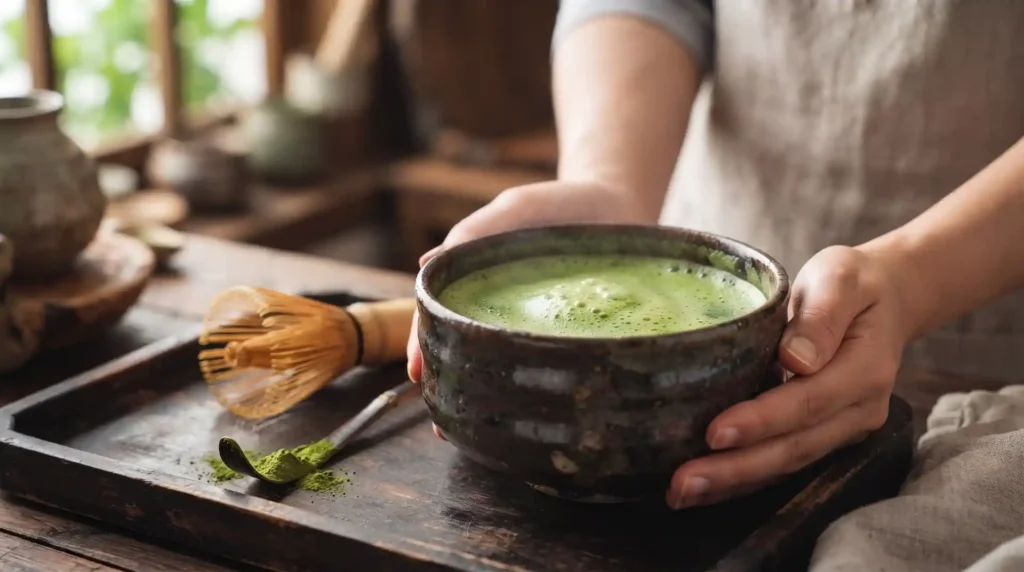
Japanese matcha powder has a story that reaches back more than a thousand years. It is more than a bright green tea. It represents centuries of tradition, craftsmanship, culture, and careful preparation.
Japanese matcha powder now appears in traditional tea ceremonies, modern cafés, smoothies, desserts, and everyday kitchens. However, its journey was not always this simple.
The story began with powdered tea traditions in China. From there, the practice traveled to Japan. Over time, Japanese tea farmers and tea masters developed it into the distinctive matcha known today.
So, how did a simple powdered tea become such an important part of Japanese culture?
Let’s take a closer look.
THE ANCIENT ROOTS OF JAPANESE MATCHA POWDER
The history of tea in China closely connects to the history of Japanese matcha powder.
During the Tang and Song dynasties, people processed tea very differently from the loose-leaf teas many people drink today. They compressed tea leaves into cakes, ground the cakes into powder, and prepared the powder with hot water.
During the Song dynasty, people refined powdered tea by whisking it with hot water to create a frothy drink.
This method eventually influenced Japanese tea culture.
However, it is important to understand that modern Japanese matcha powder did not simply appear in China and remain unchanged. What happened after powdered tea traditions reached Japan shaped its development.
That is where the story becomes even more fascinating.
HOW TEA REACHED JAPAN
Tea had already reached Japan centuries before modern matcha developed. Historical records show that people in Japan were consuming tea by the ninth century.
However, the Buddhist monk Eisai strongly influenced the development of the matcha tradition.
Eisai traveled to China during the late twelfth century. After returning to Japan, he brought back tea seeds and knowledge of tea cultivation and preparation.
He also wrote Kissa Yōjōki, a work about tea and its cultivation and use.
Eisai helped spread tea culture among Buddhist communities. Gradually, tea became connected with Zen practice and Japanese cultural life.
From there, the story continued to evolve.
Japanese farmers began developing their own methods. Tea cultivation became more sophisticated. Production teams refined the techniques. Eventually, Japan developed the distinctive characteristics associated with Japanese matcha powder today.
THE JAPANESE TRANSFORMATION OF MATCHA
One of the most important parts of the history of Japanese matcha powder is that Japan did not simply preserve an imported tradition.
It transformed it.
Over the centuries, Japanese tea producers developed techniques that changed the appearance, flavor, and texture of powdered tea.
Shade cultivation became particularly important. Tea plants used for matcha grow under shade before farmers harvest them. This changes the plant’s growth and contributes to the characteristic color and flavor of the finished tea.
The harvested leaves used for matcha undergo processing into tencha. Workers steam and dry the leaves without rolling them, unlike the process used for many other Japanese teas.
The stems and veins are then removed. Finally, the team grinds the prepared leaves into an exceptionally fine powder.
Stone mills traditionally performed this grinding.
The process is slow.
It is also precise.
That careful production is one reason authentic Japanese matcha powder has such a distinctive character. The vivid green color, fine texture, and savory umami notes reflect how producers cultivate and process the tea.
FROM ZEN TEMPLES TO THE JAPANESE TEA CEREMONY
As tea culture developed, matcha became increasingly connected with Zen Buddhist communities.
Tea is a beverage that people can enjoy. It could also become part of meditation and social interaction.
Over time, tea preparation became more deliberate.
Every movement mattered.
The bowl mattered. The whisk mattered. The water mattered. Even the way people presented the tea became meaningful.
During the Muromachi period, tea culture continued to develop. Later, tea masters such as Sen no Rikyū helped shape the Japanese tea ceremony into the refined practice associated with Japanese culture today.
The emphasis was not simply on drinking tea.
It was on the experience.
The preparation was intentional. The surroundings influenced the decision. Simplicity guided the approach
As a result, matcha became much more than powdered tea. It became part of a cultural tradition built around presence, hospitality, simplicity, and appreciation.
WHY JAPANESE MATCHA POWDER IS SO VIBRANT
Have you ever wondered why Japanese matcha powder is usually such a striking shade of green?
The answer begins in the tea field.
Shade cultivation is an important part of traditional matcha production. The tea growers protect the tea plants from direct sunlight for a period before harvesting.
This affects the chemistry of the leaves. It also contributes to matcha’s characteristic green appearance and umami-rich flavor.
After harvesting, workers process the leaves into tencha. They then finely grind the finished tencha.
The result is a powder that is much finer than ordinary ground tea leaves.
When matcha is whisked into water, the powder does not simply disappear like sugar.
Instead, tiny tea particles remain suspended in the drink.
That is why drinking Japanese matcha powder is different from drinking an ordinary cup of steeped green tea.
You are consuming the powdered tea itself.
JAPANESE MATCHA POWDER AND ITS CULTURAL VALUE
The appeal of Japanese matcha powder is not based on color alone.
Its cultural history has played an enormous role.
For centuries, matcha has been associated with Japanese tea traditions. It has been prepared in formal settings, served during ceremonies, and also enjoyed in more everyday ways.
This long history gives matcha a unique identity.
There is also something special about the preparation itself.
A bowl of matcha can look simple.
The process behind it is not.
Tea plants must be cultivated carefully. Leaves must be harvested at the right stage. They must be processed correctly. Tencha must be stored appropriately. Then, it must be ground into a fine powder.
Each stage matters.
That attention to detail is one reason Japanese matcha powder continues to attract tea lovers around the world.
FROM TRADITIONAL BOWLS TO MODERN KITCHENS
For a long time, matcha was strongly associated with traditional Japanese tea culture.
Today, however, it has moved far beyond the tea room.
Japanese matcha powder is now used in matcha lattes, iced drinks, desserts, baked goods, smoothies, and other recipes.
This modern popularity has introduced matcha to people who may never have experienced a Japanese tea ceremony.
A traditional bowl of whisked matcha and a modern iced matcha latte may look completely different.
Yet they share the same foundation.
Both begin with finely ground matcha.
This is one of the most interesting parts of matcha’s modern story. A centuries-old tradition has been adapted to contemporary lifestyles without completely losing its identity.
The preparation may change.
The appreciation remains.
HOW TO ENJOY JAPANESE MATCHA POWDER TODAY
You do not need an elaborate tea room to enjoy Japanese matcha powder.
A simple preparation can be enough.
Start with a small amount of matcha powder. Add it to warm water. Then whisk until the powder is evenly mixed and a light layer of foam forms on top.
For a creamier drink, milk can be added.
You can also prepare an iced matcha drink. Simply mix the matcha with a small amount of warm water first. Then add cold water, milk, or ice.
Another option is a smoothie.
A small amount of Japanese matcha powder can add its distinctive color and flavor to a morning smoothie.
For baking, matcha can also be added to recipes such as cookies, cakes, and other desserts.
The possibilities are surprisingly broad.
THE HISTORY BEHIND EVERY SIP
There is something meaningful about knowing where your tea comes from.
When you prepare Japanese matcha powder today, you are participating in a tradition shaped by centuries of cultural exchange and Japanese craftsmanship.
The journey began with ancient powdered tea traditions in China.
It continued through Buddhist communities in Japan.
Then, Japanese farmers refined cultivation and processing methods. Tea masters developed new ways of appreciating the drink. The tea ceremony gave matcha a deeper cultural identity.
Eventually, matcha crossed borders again.
This time, it traveled around the world.
Today, Japanese matcha powder is enjoyed by people from many different cultures. Some drink it traditionally. Others prefer lattes. Some use it in smoothies. Others enjoy it in desserts.
That flexibility is part of what makes matcha so remarkable.
It has changed with the times.
Yet its history remains visible in every bright green bowl.
WHY THE STORY OF MATCHA STILL MATTERS
The history of Japanese matcha powder is ultimately a story of transformation.
A powdered tea tradition traveled across borders.
Japan gave it a distinctive identity.
Farmers refined the cultivation process. Craftspeople refined the production process. Tea masters refined the ritual.
Generations continued the tradition.
Now, modern tea lovers are discovering it again.
That connection between old and new is what makes Japanese matcha powder so fascinating. It belongs to history, but it also belongs in the modern kitchen.
With Canny Herbs Japanese Matcha Tea Powder, you can bring a taste of this remarkable tradition into your everyday routine.
Whether you prefer a traditional cup, a creamy latte, an iced drink, or a creative recipe, every serving offers an opportunity to experience a small part of matcha’s extraordinary journey.
The next time you whisk a bowl of matcha, remember that you are not simply preparing a green drink.
You are preparing a tea with a story.
A story that began centuries ago, crossed cultures, and continues to evolve.
And that is what makes Japanese matcha powder more than a trend.
It is a timeless tradition that continues to find a place in modern life.